


The Difference Between Looking Clean and Being Clean
There’s a difference between a home that looks clean and a home that is clean.
And if we’re being honest, most people have been taught to judge cleanliness by a handful of surface-level clues:
- Does it shine?
- Does it smell fresh?
- Are there crumbs, dust, or visible smudges?
- Does the room look tidy?
If the answer is yes, we tend to think, Great. Clean enough.
But that’s exactly where a lot of everyday cleaning goes sideways.
Because “looking clean” is mostly visual.
“Being clean” is about what’s actually happening on the surface, in the air, and in the environment your family lives in every day.
That difference matters more than most people realize—especially in homes where people are eating at the counters, kids are doing homework at the island, pets are climbing onto furniture, and everyone’s hands are constantly touching the same surfaces over and over again.
A clean-looking home can still have residue buildup. It can still have grime trapped under product layers. It can still have odors being masked instead of removed. It can still leave behind that film you can’t quite see but somehow always feel.
And once you notice that difference, you can’t unsee it.
Why Most People Confuse Appearance With Cleanliness
This isn’t because homeowners are careless. It’s because we’ve been trained to read the wrong signals.
For years, cleaning products and cleaning ads have taught people to equate cleanliness with a certain look and smell:
- glossy counters
- streak-free glass
- bright white foam
- lemon scent
- that “just cleaned” perfume in the air
Those cues are powerful because they feel immediate. You wipe, you spray, you smell something “fresh,” and your brain says: Mission accomplished.
But visual impact and fragrance are not the same thing as genuine cleanliness.
A countertop can sparkle and still have a layer of product sitting on it. A floor can shine and still be holding onto old residue. A bathroom can smell strongly “clean” while the odor is actually being covered instead of solved.
This is one of the biggest misconceptions in residential cleaning: people assume that if something looks better, it is better.
Sometimes it is. Sometimes it’s just better staged.
The “Clean Illusion” Happens More Than You Think
Let’s talk about the clean illusion, because this shows up in homes all the time.
The clean illusion happens when a surface gives off all the signs of being clean—but those signs are mostly cosmetic.
That might mean:
- a countertop that shines because of leftover product
- a floor that feels slick, not because it’s clean, but because it has buildup
- a room that smells fresh because fragrance is lingering
- a bathroom sink that looks polished but still has film around the faucet base
- a dining table that looks spotless but has layers of old cleaner trapped in the finish
This is especially common in kitchens, bathrooms, and high-touch areas where surfaces are cleaned often but not always cleaned well.
And no, that’s not a judgment. It’s just reality.
A lot of common products are designed to deliver a fast visual result. They’re made to impress you in the moment. What they are not always designed to do is leave the surface truly reset and residue-free.
That’s a huge difference.
Also Read 📖https://shelleesgreenclean.com/what-cleaning-labels-dont-tell-you/
Why Shine Can Be Misleading
Shine is one of the biggest false signals in household cleaning.
People love shine (even I am guilty of this) because it feels like proof. If the counter glows or the floor catches the light, it feels reassuring.
But shine can come from a few different things:
- a genuinely clean surface
- a polished coating or film
- product residue left behind after wiping
Those are not the same thing.
In fact, sometimes the very thing people think means “extra clean” is actually evidence that something has been layered onto the surface.
This is why some counters look beautiful right after cleaning but then seem to pick up fingerprints, crumbs, dust, or haze faster than they should. The product may have created temporary visual payoff while also leaving behind a surface that grabs onto more mess later.
That’s not a better clean. That’s a high-maintenance clean.
And for busy homeowners, high-maintenance clean is exhausting.
Why Smell Can Be Misleading Too
Scent is another big one.
A lot of people grew up associating strong fragrance with a clean home. If the kitchen smelled citrusy or the bathroom smelled floral, that meant somebody had cleaned.
But fragrance is not proof of removal.
It’s proof that something smells like fragrance.
Sometimes that fragrance is just sitting on top of the problem. Sometimes it’s mixing with the underlying odor instead of eliminating it. Sometimes it’s lingering on the surfaces themselves.
And here’s the part that matters for families: in a home, surfaces are not just decorative. They are lived on.
Kids lean on counters. Arms rest on islands. Snacks get set down. Hands touch everything. Pets jump up where they shouldn’t. Life happens on those surfaces.
So when the “clean feeling” comes mostly from scent and shine, rather than true removal, you’re not getting the kind of clean most people think they are.
You’re getting a performance.
Also Read 📖When Strong Smell Started Meaning “Effective” — and Why It’s Misleading
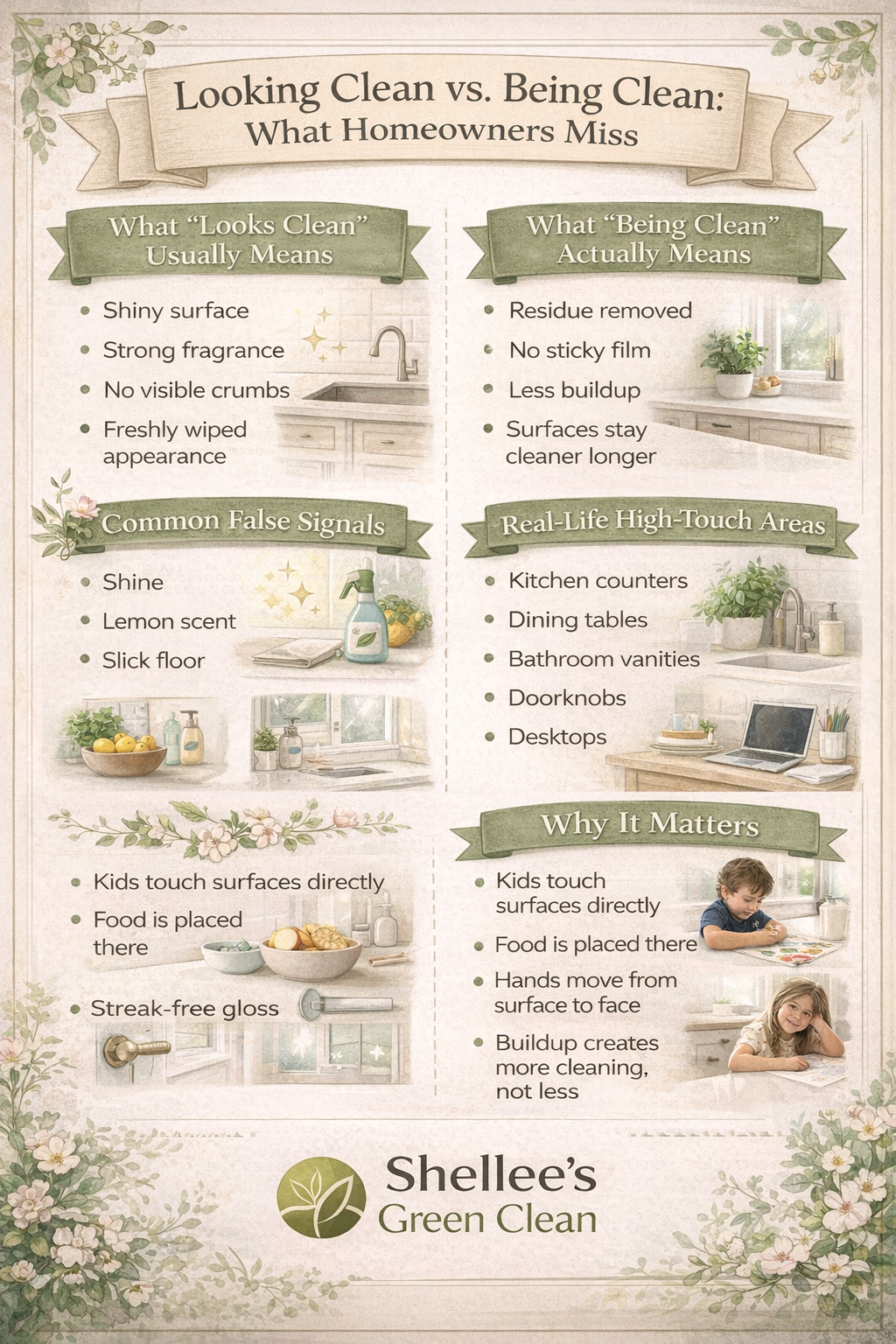
Real Clean Is About Removal, Not Appearance
Here’s the simplest way to say it:
Looking clean is about presentation.
Being clean is about removal.
We don't have to cross boundaries and become Germ-a-phobes, but we really do need to look a little closer at our own versions of clean.
A truly clean surface is one where the unwanted material has actually been taken away—not just spread around, covered up, glossed over, or fragranced into submission.
That includes things like:
- food residue
- grease film
- soap buildup
- sticky product layers
- tracked-in grime
- dust that has bonded to leftover cleaner
- organic messes in kitchens and bathrooms
- old residue from repeated spray-and-wipe habits
Being clean means the surface has been brought back closer to its natural state.
Not perfumed.
Not coated.
Not made temporarily shiny.
Actually cleaned.
That’s why a truly clean home often feels different in a way that’s hard to explain if you haven’t experienced it.
The counters feel cleaner. The air feels lighter. The surfaces don’t feel tacky. The home holds that fresh feeling longer without constantly demanding more product.
That’s the difference.
A Kitchen Counter Is the Perfect Example

If you want one place where this matters most, it’s the kitchen counter.
Think about what happens there every day:
- groceries get dropped there
- kids color there
- someone leans there while talking on the phone
- people prep food there
- mail lands there
- backpacks, purses, lunch bags, and hands all touch it constantly
- Don't forget the furry felines that like to be king/Queen of the realm
Now think about how often the average kitchen counter gets “cleaned.”
Usually it gets a quick wipe. Maybe a spray. Maybe a paper towel. Maybe whatever product is closest to the sink.
And visually? It may look great.
But if that routine is leaving behind a light film, or if the product is mostly creating shine instead of removing buildup, then that surface is not as clean as it appears.
That matters because countertops are not passive surfaces. They’re active family surfaces.
When children sit at the counter eating snacks and coloring, their hands touch it. Their arms rest on it. Their skin makes contact with it. Food touches it. Papers and crayons move across it.
So this isn’t just a technical cleaning debate. It’s practical.
When a surface is used that intimately, “looks clean” is not the standard you want to stop at.
Also Read 📖The Science of Odor Elimination: What Freshener Companies Don’t Want You to Know
Why High-Touch Surfaces Need a Higher Standard
One of the biggest mistakes in everyday home cleaning is using the same visual standard for every surface.
A decorative mirror? Fine. If it looks clean, that’s a big part of the job.
A bookshelf? Sure, appearance matters a lot.
But the surfaces your family touches constantly need a different lens.
That includes:
- kitchen counters
- bathroom vanities
- dining tables
- refrigerator handles
- stair rails
- doorknobs
- light switches
- coffee tables
- desktops
- kids’ workspaces
These are real-life contact zones. And in those spaces, being clean matters more than looking polished.
Because what you want on those surfaces is not a glossy finish and a fake-fresh smell. What you want is less residue, less buildup, and less transfer from surface to hand to food to face to daily life.
That’s where smarter cleaning starts to matter.
Why Some Homes Never Quite Feel Clean Even When They’re Tidy
This is a feeling a lot of homeowners have, even if they can’t put it into words.
The house is picked up. The counters are wiped. The floors were mopped. The bathroom was cleaned.
And yet… it still doesn’t feel clean.
That feeling usually comes from one of a few things:
- residue on surfaces
- fragrance masking instead of removing
- buildup from repeated product use
- grime trapped in high-use areas
- visual tidiness without true surface reset
That “not quite fresh” feeling is often the gap between maintenance and real cleaning.
And it’s frustrating, because homeowners then assume the answer is to use more product, stronger product, or more frequent product.
But very often the answer is the opposite: less layering, better removal.
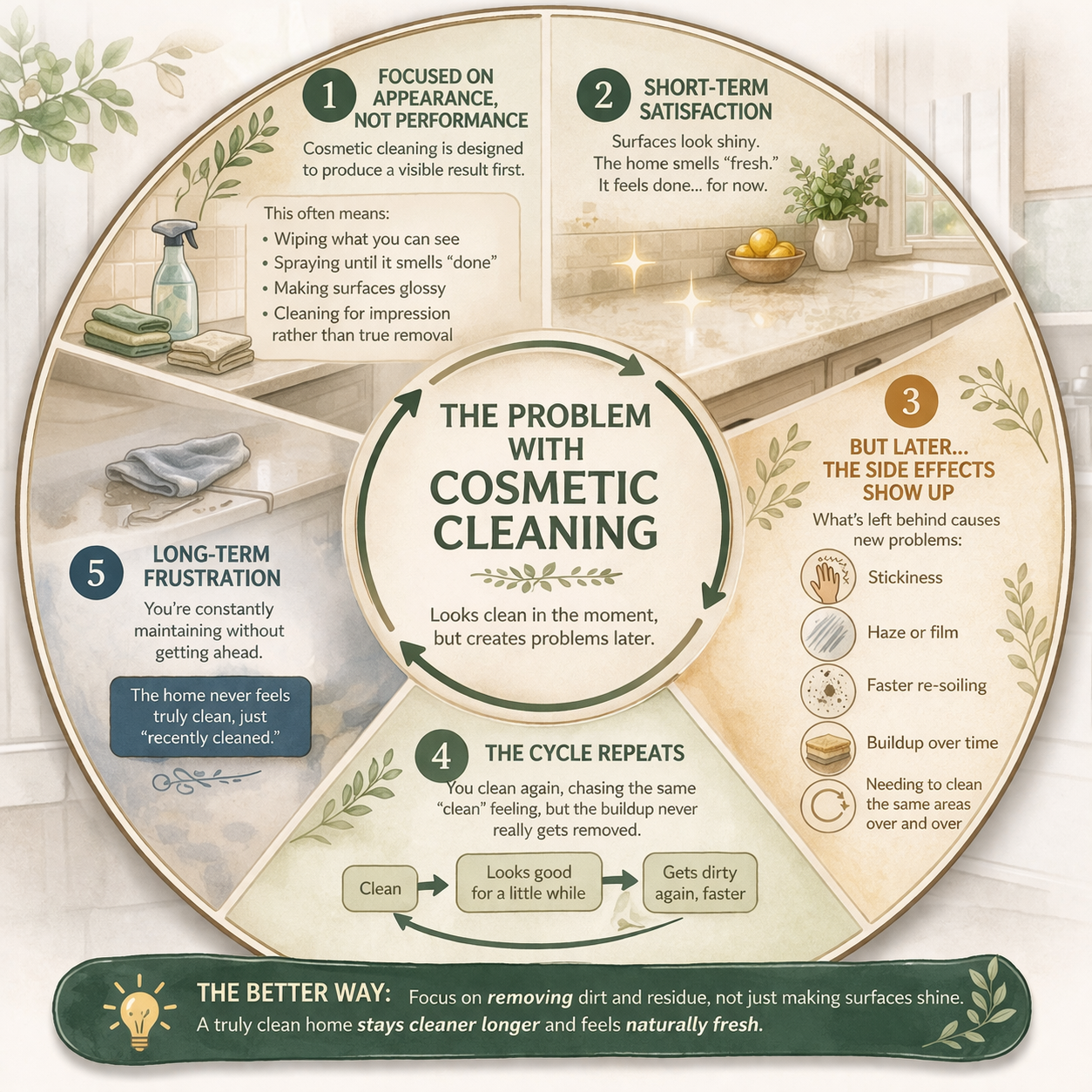
What a Truly Clean Home Feels Like
A truly clean home is often less dramatic than people expect.
It does not always scream for attention. It doesn’t need an overpowering smell. It doesn’t rely on artificial signals.
Instead, it feels:
- lighter
- more settled
- less coated
- less sticky
- easier to maintain
- naturally fresh instead of fragranced fresh
The counters feel like the actual counter, not a layer sitting on top of it. The floors don’t feel filmy under bare feet. The bathroom feels reset rather than perfumed. The kitchen feels like a place you can use immediately without second-guessing the surfaces.
That’s the kind of clean homeowners usually want. They just haven’t always been shown how different it is from cosmetic clean.
What Shellee’s Green Clean Believes About “Real Clean”
At Shellee’s Green Clean, the goal isn’t to create a performance of cleanliness. It’s to create the real thing.
That means looking beyond:
- heavy fragrance ( I do love my candles)
- overly glossy results (Floors don't look clean unless they shine, right?)
- quick visual payoff that fades fast (quick wipe on your way by)
- buildup-producing routines (Who uses dust polish anymore?)
And instead focusing on what actually makes a home feel better to live in:
- surfaces that are genuinely cleared of residue and grime
- spaces that feel naturally fresh
- less leftover product sitting where your family lives, touches, eats, and gathers
- results that hold up instead of disappearing by the next day
That’s a very different philosophy from “make it look clean fast.”
It’s slower thinking. Smarter thinking. And honestly, more respectful of the home itself.
Because your home isn’t a showroom. It’s where your life happens.
Why This Matters for Families, Not Just Clean Freaks

This conversation is not just for people who are super particular about housework.
It matters for regular families.
It matters for the parent packing lunches on a wiped-down counter.
It matters for the child doing homework at the island.
It matters for the family eating snacks straight off a plate placed on the surface.
It matters for people trying to create a healthier-feeling home without constantly fighting clutter, dust, residue, and re-cleaning.
When you understand the difference between looking clean and being clean, your standards shift in a useful way.
You stop chasing fake signals.
You start paying attention to outcomes.
You notice which products and routines are helping—and which ones are just putting on a little show.
That awareness changes everything.
So How Can You Tell the Difference?
If you want to know whether something is truly clean instead of just visually clean, ask questions like these:
- Does the surface feel natural, or coated?
- Does it stay cleaner longer, or get grimy again fast?
- Is there a strong fragrance doing a lot of the “clean” work?
- Do fingerprints, crumbs, or dust seem to cling unusually quickly?
- Does the home feel fresh in a natural way, or just smell heavily scented?
- Are you constantly re-cleaning the same exact areas?
Those clues matter.
Because a clean home shouldn’t require endless product and endless repetition just to maintain the illusion.
Things To Think About
The difference between looking clean and being clean is bigger than most people think.
One is about what you can see in the moment.
The other is about what has actually been removed, what has been left behind, and how the home feels after the job is done.
And in real family life, that difference matters.
Because your counters are not just for show. Your tables are not just decor. Your surfaces are part of everyday living. People touch them, lean on them, eat on them, and move through them all day long.
So yes, a home should look clean. Of course it should.
But that shouldn’t be where the standard ends.
If you want a home that doesn’t just photograph well but actually feels cleaner, healthier, and easier to live in, Shellee’s Green Clean is built around that difference.
10 FAQs
1. What is the difference between looking clean and being clean?
Looking clean is mostly about appearance, such as shine, tidiness, and smell. Being clean means dirt, residue, grime, and buildup have actually been removed from the surface.
2. Can a surface look clean but still have residue on it?
Yes. Many surfaces look spotless even while a layer of product residue remains behind. That film may not be obvious at first, but over time it can affect how the surface feels and how quickly it gets dirty again.
3. Does shiny mean a countertop is truly clean?
Not always. Shine can come from actual cleanliness, but it can also come from leftover cleaning product or a polished coating that stays on the surface after wiping.
4. Why does my home look clean but still not feel fresh?
That often happens when cleaning is mostly cosmetic. If residue, buildup, or masked odors remain, the home can look tidy without feeling truly clean.
5. Are strong-smelling cleaners better at cleaning?
No. A strong smell may create the impression of cleanliness, but fragrance does not guarantee that dirt, grime, or residue has been removed.
6. Why do my counters get sticky even though I clean them every day?
Daily cleaning can still lead to sticky counters if the product being used leaves a residue behind. Over time, that buildup creates a tacky feel and attracts more mess.
7. Why do high-touch surfaces need extra attention?
High-touch surfaces like kitchen counters, tables, and bathroom vanities are used constantly by hands, arms, food items, and everyday household activity. They need more than a quick visual wipe because people interact with them directly.
8. What are signs that a surface is not truly clean?
Common signs include stickiness, haze, recurring grime, fast re-soiling, heavy fragrance, or a surface that looks nice but never quite feels fresh.
9. Why does residue matter in a family home?
Residue matters because it sits on surfaces people touch every day. In family homes, that includes places where children eat, color, lean, and rest their arms, especially in kitchens and dining areas.
10. What makes professional green cleaning different from regular cleaning?
Professional green cleaning focuses on removing buildup and mess without relying on heavy fragrances or residue-producing products. The result is a home that feels cleaner, not just one that looks freshly wiped.