


When “Fresh” Is Just a Perfume 🎋
Walk into almost any home, hotel, or office and you’ll notice it immediately—that familiar “clean” scent. Maybe it smells like lavender fields, citrus groves, or ocean breezes. We’ve been trained to believe those scents mean something has been cleaned.
But from a chemistry perspective, scent and cleanliness are not the same thing.
Many room sprays, laundry detergents, and household cleaners don’t actually eliminate odors at all. Instead, they release fragrance molecules designed to overpower the human nose and mask the unwanted smell.
In other words, the odor may still be present on a molecular level—our brain is simply distracted from noticing it.
Understanding the difference between odor masking and odor elimination opens a fascinating window into the science of indoor air.
And once you see it, you can’t unsee it. 🔬
Your Nose Is a Tiny Chemical Laboratory 👃
The human sense of smell is extraordinary. Scientists estimate our noses contain around 400 different odor receptors, capable of detecting thousands of airborne molecules.
When volatile compounds float through the air and reach the nose, they bind to those receptors and send signals to the brain.
Your brain then translates that signal into a smell.
Two important things follow from this:
• Odors are simply molecules floating in the air
• If those molecules remain present, the odor technically still exists
Many fragranced products take advantage of this biology. By releasing stronger scent molecules into the air, they effectively crowd the sensory system, making the original odor harder to detect.
The smell disappears to our perception—but not necessarily in reality.
That’s what chemists call odor masking.
What’s Actually Inside Fragrance Products? 🌸
Modern fragrances are incredibly complex. A single scent blend can contain dozens or even hundreds of chemical compounds carefully combined to produce a specific aroma.
These mixtures may include:
• Terpenes – compounds that create citrus, pine, or floral aromas
• Synthetic musks – ingredients designed to make scents last longer
• Solvents – substances that help disperse fragrance into the air
• Stabilizers – compounds that help maintain shelf life
Here’s something many consumers don’t realize: in most countries, companies can legally list all of these ingredients simply as “fragrance” or “parfum.”
This is allowed because fragrance formulas are considered proprietary trade secrets.
That doesn’t mean every fragrance is unsafe—but it does mean consumers often don’t see the full list of chemicals involved.
Transparency has been a growing topic in the world of indoor air quality.
Indoor Air Chemistry Is More Active Than You Think 🏡

The air inside our homes isn’t chemically quiet.
When fragrance molecules are released indoors, they can interact with other compounds already present in the air.
For example, terpenes—the chemicals responsible for many citrus and pine scents—can react with small amounts of ozone that naturally enter buildings from outside air.
Scientists studying indoor air chemistry have observed that these reactions can create new compounds, including tiny airborne particles or secondary chemicals.
In most homes the concentrations remain low, but the key point is fascinating:
Indoor air is not static.
It’s a living chemical environment where molecules are constantly reacting and transforming.
Why Some People React to Fragrances 🤧
Many people use scented products daily without any noticeable effects.
However, some individuals report sensitivities that may include:
• Headaches
• Respiratory irritation
• Skin irritation
• Asthma symptom aggravation
Researchers often refer to this as fragrance sensitivity.
Because fragrance formulas contain many compounds, it can be difficult to pinpoint which ingredient causes a reaction in any particular case. Some responses may involve true allergies, while others may simply be irritation from airborne chemicals.
The American Academy of Dermatology notes that fragrance ingredients are among the most common triggers of contact dermatitis in cosmetics and personal care products.
This is one reason fragrance-free or low-scent cleaning products have become increasingly popular.
The Hormone Disruption Conversation ⚖️
Another topic that sometimes appears in discussions about fragranced products is endocrine disruption.
Endocrine disruptors are chemicals that may interfere with the body’s hormone signaling systems.
Certain compounds historically used in fragrance mixtures—such as some phthalates—have been studied in laboratory and epidemiological research for potential hormone-related effects.
Because of growing consumer awareness and regulatory attention, many manufacturers have reduced or eliminated specific phthalates from products over the past two decades.
Scientific understanding in this area continues to evolve, but the conversation has encouraged companies to rethink fragrance formulations and improve ingredient transparency.
Masking Odors vs Eliminating Them 🔍
Here’s the key scientific difference.
Masking an odor means introducing stronger fragrance molecules to overwhelm the smell.
Eliminating an odor means chemically changing or removing the molecules that cause the smell in the first place.
True odor removal usually involves one of several processes:
• Oxidation – breaking odor molecules apart through chemical reactions
• Adsorption – trapping odor molecules in materials like activated carbon
• Biological processes – enzymes or microbes that digest odor sources
In these cases, the original odor compounds are actually altered or removed, not just hidden.
A Science-Based Approach to Odor Neutralization ⚗️
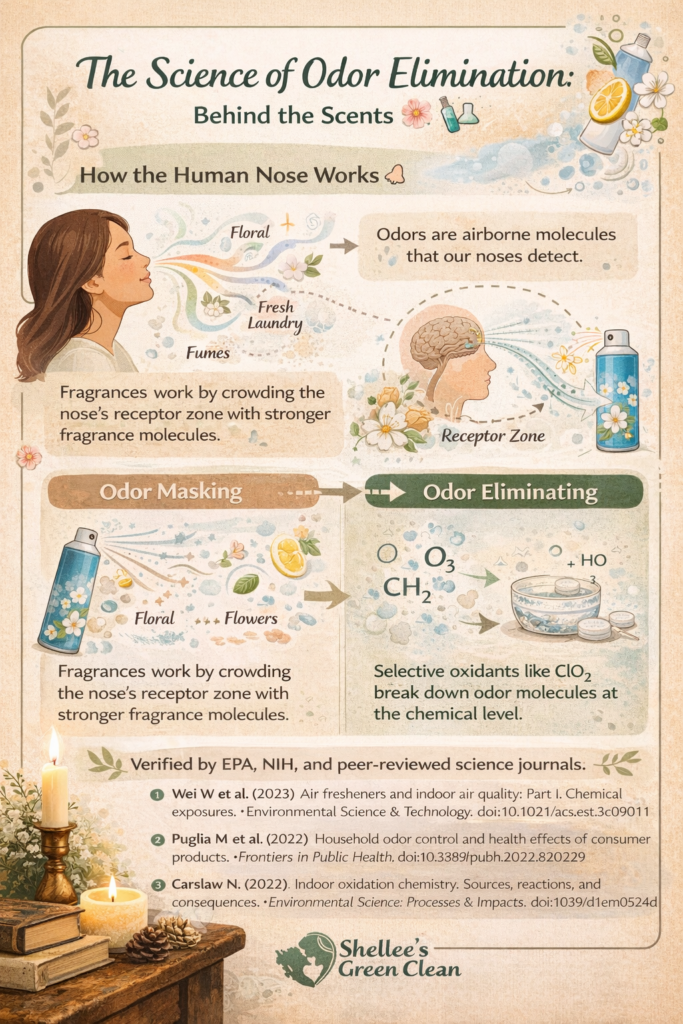
One approach used in water purification and sanitation science involves oxidation chemistry.
Oxidation occurs when a compound reacts with oxygen or other reactive molecules, breaking larger odor molecules into smaller, less noticeable ones.
A well-known oxidizing agent used in municipal water treatment is chlorine dioxide (ClO₂).
Unlike chlorine bleach, chlorine dioxide acts through selective oxidation reactions that target many odor-producing compounds, especially sulfur-based molecules responsible for strong smells.
Because it changes those molecules chemically, the odor is neutralized rather than masked.
For decades, chlorine dioxide has been used in:
• Municipal drinking water treatment
• Food processing sanitation
• Hospital disinfection
• Industrial odor control
Its role in odor neutralization comes from basic chemistry: alter the molecule, and the smell disappears.
The Future of “Clean” Air 🌬️
As people become more aware of indoor air quality, the conversation around cleaning products is evolving.
Consumers are beginning to ask smarter questions:
• What ingredients are actually in this product?
• Does this remove odors or simply cover them up?
• How does it affect the air inside my home?
The next generation of cleaning solutions will likely focus on three principles:
✨ Ingredient transparency
✨ Lower fragrance loads
✨ Science-based odor neutralization
Because truly clean air shouldn’t need perfume to prove it.
Rethinking What “Fresh” Really Means 🌿
For decades, we’ve associated strong scents with cleanliness.
But chemistry tells a more nuanced story.
Fragrance can make a room smell pleasant, but it doesn’t necessarily remove the molecules causing the odor. True odor elimination happens when those molecules are chemically changed or physically removed.
Understanding that difference helps families choose cleaning solutions that address the root cause rather than simply covering it up.
Real freshness isn’t about adding more scent.
It’s about removing what shouldn’t be there in the first place.
There’s something deeply comforting about a home that feels peaceful. A warm lamp in the corner, a favorite book on the table, maybe a candle flickering softly while the evening settles in. For generations, families have tried to create that feeling of “freshness” in their homes, often guided by whatever products promised the cleanest scent.
But the truth is, the more we learn about the science of our homes, the more we realize that true freshness isn’t about covering the air with perfume. It’s about understanding what’s actually happening around us—what we breathe, what we clean with, and how the tiny invisible molecules in our homes interact with our bodies.
At Shellee’s Green Clean, the goal has never been to create fear or shame around the products people have used for years. Most of us grew up with them. They were part of the rhythm of everyday life. Instead, the goal is something much simpler and much kinder: education.
Because when people understand the science behind odor, indoor air, and cleaning chemistry, they gain the power to make better choices for their homes and families. Not perfect choices—just informed ones.
Knowledge has a gentle way of changing things.
Maybe it leads someone to open a window more often. Maybe it inspires a switch to simpler cleaning solutions. Maybe it simply helps someone realize that a home doesn’t need to smell like a perfume counter to be truly clean.
A home can smell like fresh air.
Like clean fabrics drying in the sunlight.
Like dinner cooking in the kitchen.
Those quiet, natural scents have always been the real markers of a healthy home.
And the more we learn, the more we discover that clean living doesn’t come from stronger fragrances—it comes from smarter science and a little bit of thoughtful care. 🌿
Frequently Asked Questions

1. Do air fresheners actually remove odors?
Most traditional air fresheners do not remove odors at the molecular level. Instead, they release fragrance compounds designed to overpower or distract the nose from detecting unpleasant smells. This process is called odor masking. The original odor molecules may still be present in the air or on surfaces even though the smell seems to disappear. True odor elimination requires chemically altering or removing the compounds responsible for the smell.
2. What causes odors in a home in the first place?
Odors are created by volatile organic compounds (VOCs)—tiny molecules released into the air from substances like food, bacteria, mold, smoke, or organic waste. These molecules evaporate easily and travel through the air until they reach odor receptors in the nose. When the brain interprets those signals, we perceive them as smells. Removing or neutralizing the source of those molecules is the most effective way to eliminate odors.
3. What does it mean when a product “masks” an odor?
Odor masking occurs when a product releases stronger scent molecules that compete with unpleasant odor molecules for the nose’s attention. Because the human brain tends to notice the strongest signal, the fragrance overwhelms the odor. The underlying smell may still exist, but the added fragrance makes it harder to detect. Many scented sprays, plug-ins, and fragranced detergents rely on this method.
4. Why do some people get headaches or irritation from scented products?
Some individuals experience reactions to fragrance compounds because the mixtures contain many different chemicals. For certain people, exposure can trigger irritation of the respiratory system, skin reactions, headaches, or asthma symptoms. The American Academy of Dermatology identifies fragrance ingredients as one of the most common causes of cosmetic-related skin allergies. Sensitivity varies widely from person to person, which is why fragrance-free alternatives are often recommended for those who experience symptoms.
5. What are terpenes and why are they used in fragrances?
Terpenes are natural compounds found in plants that give many fruits, herbs, and trees their characteristic scent. For example, limonene creates citrus aromas and pinene produces pine-like scents. These compounds are often used in cleaning products and air fresheners to create fresh-smelling fragrances. However, when terpenes are released indoors they can sometimes react with ozone in the air, producing additional byproducts and particles as part of normal indoor air chemistry.
6. Are fragrance ingredients required to be listed on product labels?
In many countries, manufacturers are allowed to list fragrance blends simply as “fragrance” or “parfum” on product labels rather than identifying every individual compound. This rule exists because fragrance formulas are considered proprietary trade secrets. While this protects intellectual property for companies, it can also make it difficult for consumers to know exactly which ingredients are present in a product.
7. What are endocrine disruptors and why are they sometimes discussed with fragrances?
Endocrine disruptors are chemicals that may interfere with the body’s hormone signaling systems. Some compounds historically used in fragrance formulations, including certain phthalates, have been studied for possible endocrine effects in laboratory and population studies. Due to increasing scientific attention and consumer awareness, many manufacturers have already reduced or removed specific phthalates from consumer products. Research in this area continues as scientists work to better understand long-term exposure and health outcomes.
8. What methods actually eliminate odors instead of masking them?
True odor removal occurs when the molecules responsible for the smell are physically removed or chemically changed. Common approaches include:
• Oxidation, which breaks odor molecules apart through chemical reactions
• Adsorption, where materials such as activated carbon trap odor molecules
• Biological breakdown, where enzymes or microbes digest odor-causing substances
These methods address the underlying cause rather than simply covering up the smell.
9. Why is indoor air quality becoming such an important topic?
People today spend roughly 90% of their time indoors, according to environmental health studies. Because of this, scientists are paying closer attention to the chemical makeup of indoor air. Cleaning products, fragrances, cooking emissions, and building materials can all contribute to indoor air chemistry. Understanding how these factors interact helps researchers develop safer and more effective ways to maintain healthy indoor environments.
10. What is the difference between smelling “clean” and actually being clean?
A pleasant scent can make a space feel fresh, but it does not necessarily indicate that odor-causing molecules have been removed. True cleanliness comes from removing or neutralizing the substances responsible for odors, bacteria, or contaminants, not simply adding fragrance to the air. In many cases, eliminating the source of an odor—through cleaning, ventilation, or chemical neutralization—provides a more lasting solution than masking the smell.