


The Smell of “Clean” Had a Very Specific Personality
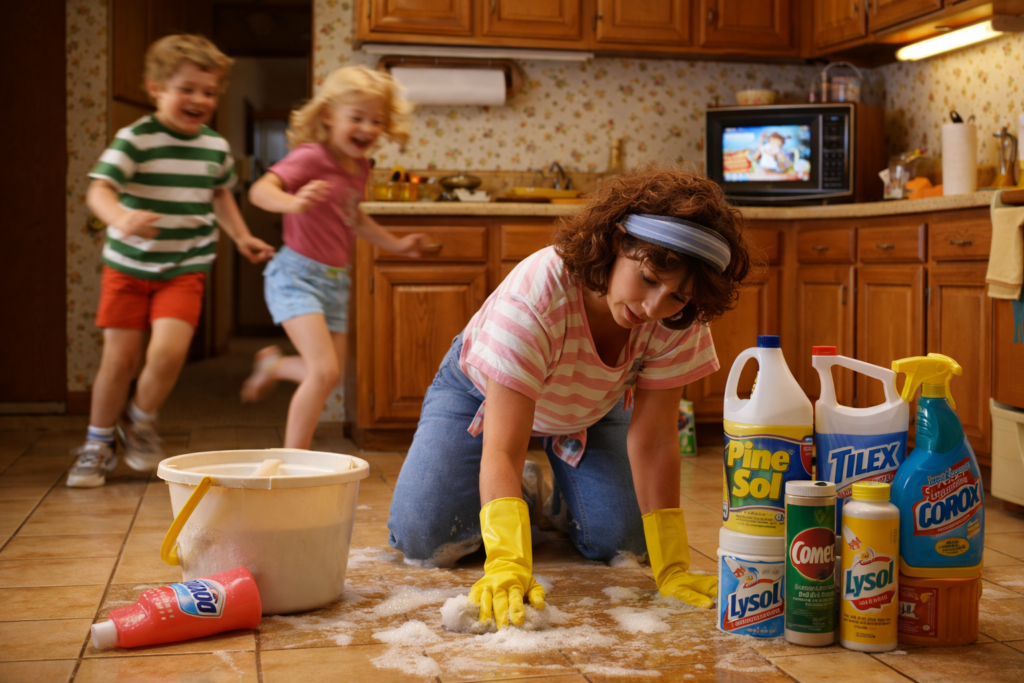
If you grew up in the 70s, 80s, or 90s, you know exactly what clean smelled like.
It was sharp.
It burned your nose just a little.
It lingered long after the mop bucket was dumped.
Clean smelled like lemon so bright it almost stung.
Like pine forests that clearly did not exist inside your kitchen.
Like bleach — unmistakable, commanding, impossible to ignore.
When those smells filled the house, you didn’t question whether something was clean. You felt it. Your eyes watered, your sinuses noticed, and your brain quietly logged the message:
Strong smell = effective cleaning.
No one sat us down and explained this. We absorbed it through repetition. Through parents cleaning on Saturday mornings. Through school hallways. Through public restrooms. Through TV commercials where a single spray made everything sparkle while the narrator confidently promised “mountain fresh,” “lemon power,” or “hospital clean.”
Smell became proof.
How a Sensory Shortcut Became a Cultural Belief
Here’s the sneaky part: our brains love shortcuts.
Smell is one of the fastest ways information reaches the brain. It bypasses logic and heads straight for memory and emotion. That’s why a single scent can drop you into childhood in half a second.
Manufacturers learned this early.
If a product smelled powerful, people trusted it was doing something powerful — even if the smell had nothing to do with cleaning at all.
Bleach didn’t just disinfect. It announced itself.
Pine didn’t just deodorize. It performed “outdoorsy purity.”
Lemon didn’t just cut grease. It symbolized freshness and order.
Over time, the smell became the reassurance — not the results.
Fast-Forward to Today: Same Story, New Packaging
Here’s where it gets interesting.
We’ve changed labels.
We’ve softened colors.
We’ve added words like natural, fresh, botanical, and inspired by nature.
But the message hasn’t changed much.
Commercial after commercial still tells us that clean smells like:
-
Fresh linen
-
Lavender fields
-
Morning rain
-
Spring breeze
-
Floral bouquets that no real home actually smells like
These scents don’t eliminate odors. They cover them. They replace one smell with another and call it success.
And because we were trained early, our brains still nod along.
“It smells clean, so it must be clean.”
Also Read 🌿Why I Stopped Trusting “That Clean Smell”
Masking Isn’t Cleaning — It’s Air Freshening
Let’s separate two ideas that were accidentally fused together decades ago:
-
Odor removal: actually breaking down odor-causing compounds
-
Odor masking: overpowering one smell with another
Most scented cleaners lean heavily on the second.
If a trash can smells, adding flowers doesn’t remove the trash — it just creates floral trash.
If a bathroom smells musty, lavender doesn’t fix moisture or bacteria — it perfumes them.
Real cleaning is quieter than we were taught to expect. It doesn’t need to shout.
Also Read
Why This Matters More Than Ever
Strong fragrances don’t just mislead — they can create problems of their own.
Many synthetic scents are made from complex chemical blends designed to linger. That lingering is what we were taught to love, but it’s also what can:
- Irritate airways
- Trigger headaches or migraines
- Aggravate asthma or allergies
- Leave residues that never really disappear
Ironically, what we associate with “fresh” often reduces actual indoor air quality.
Clean shouldn’t come with a warning label for your lungs.
What Clean Actually Looks Like
Clean doesn’t need a dramatic scent profile.
Clean means:
- Dirt and organic matter are removed
- Microbes are reduced appropriately
- Odor-causing compounds are broken down, not disguised
- Surfaces are left neutral — not perfumed
Truly clean spaces often smell like… nothing much at all.
And that can feel unsettling at first. When you’ve been conditioned your whole life to expect a sensory reward, the absence of smell feels like something is missing.
What’s missing is the performance.
Also Read 🌿The Things You Didn’t Know About Chlorine Dioxide (ClO₂)
Rewriting the Definition of Clean
This shift doesn’t happen overnight. It happens moment by moment, when we notice ourselves equating smell with success and gently question it.
Clean is not louder.
Clean is not sharper.
Clean is not floral, piney, or lemony by default.
Clean is effective — even when it’s quiet.
And chlorine dioxide (ClO₂) is the perfect example of that truth.
For decades, we were taught to expect drama from cleaning products: sharp smells, lingering fragrances, that instant sensory punch that felt like proof. ClO₂ doesn’t play that game. It works differently — and far more intelligently.
ClO₂ doesn’t mask odors. It neutralizes them at the molecular level. Odors exist because of volatile organic compounds (VOCs). Instead of covering those compounds with a louder scent, ClO₂ oxidizes them — breaking them apart so they simply stop existing. No cover-up. No perfume duel. Just absence.
That’s why ClO₂ feels “quiet.”
There’s no lemon-aftershock.
No bleach burn in the back of your throat.
No floral fog hanging in the air to reassure you something happened.
Something did happen — it just didn’t need to announce itself.
The same applies to microbes. ClO₂ disrupts bacteria, viruses, and mold by targeting their cellular function, not by leaving behind harsh residues. Once it’s done, it converts back into simple salts and oxygen. The work is finished. The room is left neutral.
This is the part that feels unfamiliar to many people at first: real cleanliness doesn’t linger. There’s no artificial “clean smell” because there’s nothing left to hide.
ClO₂ is quiet because it’s precise.
It’s calm because it’s complete.
It doesn’t perform — it resolves.
And when you step into a space cleaned with ClO₂, what you notice isn’t a scent. You notice how the air feels lighter. How odors don’t “come back.” How your lungs don’t brace for impact.
That’s the sound of effective cleaning: silence.
In a world still obsessed with loud fragrances and false reassurance, ClO₂ offers a reset — proof that clean doesn’t need to shout to be trusted.
And once you unlearn the idea that clean must announce itself, you start to notice something surprising: your home feels calmer, your air feels lighter, and your definition of “fresh” finally belongs to you, not a commercial.
At Shellee’s Green Clean, we believe clean should be real — not theatrical.
No masking. No sensory tricks. Just results that don’t need to shout to be trusted.
Because sometimes, the cleanest smell of all… is nothing.