


Some memories do not return as dates or photographs.
They return as a feeling.
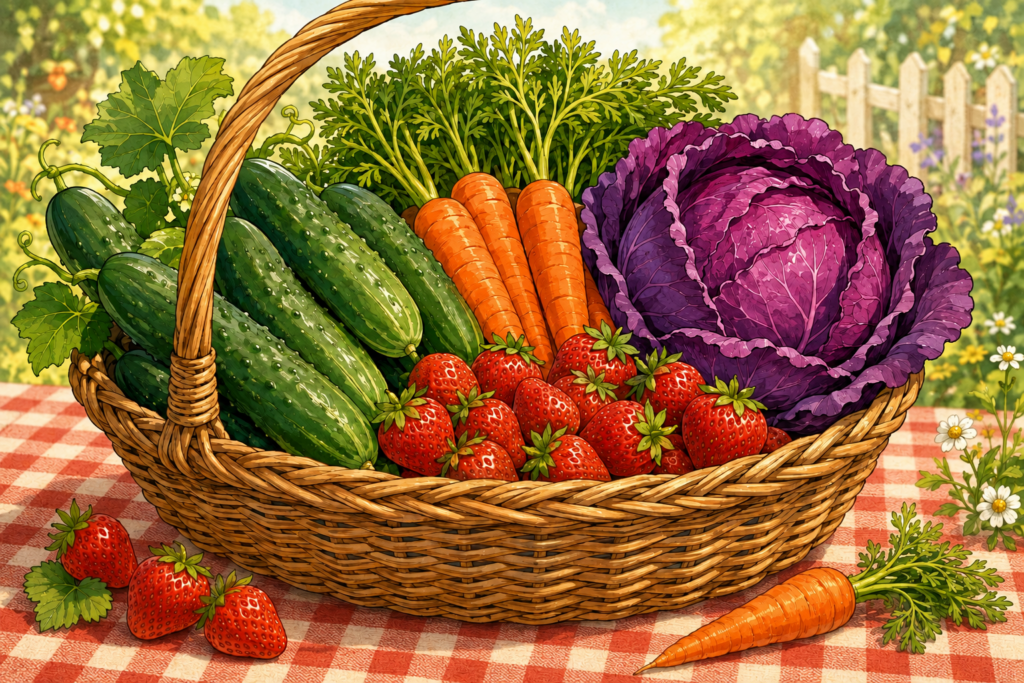
The warmth of the sun across your shoulders. The scent of tomato leaves clinging to your hands. The soft, steady hum of bees working nearby. The weight of a basket resting against your hip as you wander between rows of green beans, cucumbers and tomatoes, looking for what is ready.
I remember summer vegetables feeling almost alive in my hands.
The tomatoes were warm from the sun—not merely room temperature, but truly warm, as if they had been holding a little piece of the afternoon inside them. Cucumbers hid beneath their broad leaves, cool on one side and sun-kissed on the other. Green beans hung from their vines like tiny ribbons, and strawberries waited close to the ground, their red shoulders peeking out from beneath the leaves.
There was always something lovely about the moment a ripe tomato released from the vine with one gentle twist.
It felt like a gift.
Also Read 📖Welcome to Shellee’s Green – Nostalgia, Family & Honest Living
The Carrots We Ate Straight from the Garden
Some of my clearest childhood garden memories are of carrots.
I remember kneeling beside the garden bed and wrapping my fingers around the feathery green tops. The carrot would resist at first, holding tightly to the earth, and then suddenly release with a little tug.
Up it came—bright orange beneath a coat of dark soil, with that wonderfully fresh, earthy smell that only comes from something pulled straight from the ground.
As a child, I did not always wait for someone to carry it inside and wash it properly. I would brush away the loose dirt with my hand, wipe the carrot against my clothes and take a bite right there in the garden.
There was usually still a little soil clinging to it.
It was crunchy, sweet and somehow more exciting because I had pulled it from the earth myself. At the time, none of us gave that little bit of dirt much thought. It felt natural and harmless—just part of being a child in the garden.
Looking back, I can still feel the sunshine and hear the snap of that first bite.
And yet, knowing what we know today, it is not a habit I would recommend repeating.
Also Read 👚The Power of D-Limonene: A Smarter Way to Remove Stains Naturally
Why Garden Soil Deserves More Caution Today
Soil has never been sterile, even in a beloved backyard garden.
It may contain bacteria and other microbes introduced by wildlife, pets, manure, compost or contaminated water. Depending on the property’s history, garden soil may also contain lead, pesticide residue or other substances we cannot see, smell or taste.
A garden may look every bit as clean and peaceful as the one from childhood, but appearances cannot tell us everything that may be present in the soil.
I still want children to experience the joy of pulling a carrot from the ground. I want them to feel its weight, smell the earth and marvel that something so bright was growing beneath their feet.
I just want to carry that carrot to the sink before they take the first bite.
Sometimes caring for our families means keeping the magic while changing the ritual.
Also read 👚The Problem With One-Size-Fits-All Cleaning Products | Shellee’s Green Clean
The Garden Never Asked Us to Hurry
Garden time was different from ordinary time.
There was no rushing a tomato into ripeness. No convincing a strawberry to turn red before it was ready. You simply watered, waited and paid attention.
And somehow, those little garden habits followed us into the kitchen.
We brought everything inside in a basket, an old bowl or sometimes the folded corner of a shirt when we had gone outside without planning to pick anything. The harvest would land on the counter in a cheerful tumble—crooked cucumbers, tomatoes in every shade of red, peppers with shiny green shoulders and carrots still carrying little clumps of earth.
None of it looked perfect.
That was part of its charm.
A store-bought cucumber might be straight and polished, but the one from the garden often curled around itself as though it had changed its mind halfway through growing. The tomatoes had funny noses. The carrots sometimes came out with two legs.
They were real, and they were ours.
Also Read 👚Essential Oils vs Fragrance Oils: What’s the Real Low-Down?
From the Garden Basket to the Kitchen Sink
There was always a quiet pause between picking the vegetables and eating them.
The basket came inside. The window over the sink was open. A soft breeze moved the curtain, and somewhere outside, a lawn mower hummed in the distance.
Then the water began to run.
We washed our hands first and cleared a place around the sink. The colander came down from its hook, and one by one, the vegetables moved from the basket to the water.
It was such a simple ritual, but even then it felt important.
Homegrown food has not traveled through warehouses or passed through dozens of hands, but it has still been living outdoors. Soil settles into the leaves. Rain splashes against low-hanging vegetables. Birds fly over the garden, insects explore the plants and every now and then a curious pet wanders a bit too close.
Even the vegetables we grow ourselves should be cleaned before we cut into them or take that first crisp bite.
Not because the garden is dirty in some frightening way. Nature is not something to fear. It is simply full of life, and thoughtful cleaning helps remove soil, debris and some of the microbes that may be resting on the surface.
That is all cleaning has ever needed to be: a small act of care between the growing and the gathering, the kitchen and the table.
Cleaning Fresh Garden Produce with Chlorine Dioxide Tablets
Today, we understand more about what may be present on freshly harvested produce. We also have cleaning options our mothers and grandmothers may not have known about, including properly formulated chlorine dioxide, or ClO₂, products.
ClO₂ has long been used in certain food-processing, agricultural-water and post-harvest sanitation applications. When a ClO₂ tablet is specifically formulated and labeled for direct produce washing, it can become part of the garden-to-kitchen ritual.
Never Mix ClO₂ with Other Cleaning Products
ClO₂ tablets and prepared solutions should never be mixed with vinegar, household bleach, ammonia, acids or other cleaning products.
If the label does not clearly permit direct produce washing—or if the directions have been misplaced—use cool running water instead.
No guessing. No complicated kitchen chemistry. Just clear instructions and a steady little habit.
How to Clean Different Fruits and Vegetables from the Garden
Different kinds of produce require slightly different care. Some are firm enough for a gentle brushing, while others need the lightest touch.
Tomatoes That Still Feel Like Sunshine
Tomatoes were always my favorite.
I loved placing them beneath cool water while they were still warm from the garden. There was something so satisfying about the contrast—the heat of the afternoon giving way to the clean rush of water.
Gently rub the smooth skin with clean hands, paying special attention around the stem where a little garden dust likes to hide. Then dry the tomato with a clean towel and carry it to the cutting board.
The first slice is always the best.
The skin gives way beneath the knife, and the inside seems almost too bright to be real. Seeds glisten in their little pockets. Juice begins to gather on the board before you have finished cutting.
Sometimes the tomato becomes part of a salad.
Sometimes it lands between two pieces of bread with a little mayonnaise, salt and pepper.
And sometimes you eat the first slice right there over the kitchen sink because waiting for lunch suddenly seems unreasonable.
Cucumbers, Peppers and the Sound of Freshness
A freshly picked cucumber has a sound all its own.
The knife presses down, and the cucumber answers with a clean little snap. Inside, it is pale, cool and crisp—the complete opposite of the warm afternoon outside.
Cucumbers and other firm produce can be rinsed under running water and gently rubbed by hand. A clean produce brush can help loosen soil from textured skins and small crevices.
Peppers need a little attention around their stems and natural folds. Once they are clean and dry, they make that wonderful hollow sound beneath the knife. The top lifts away, revealing the neat cluster of seeds inside, as though nature packed everything with remarkable precision.
We used to cut cucumbers into thick coins and sprinkle them with salt. Nothing fancy. Nothing that required a recipe card.
We ate them standing beside the counter while deciding what to make with the rest.
Somehow, the first few slices never reached the table.
Lettuce Leaves and Other Garden Greens
Leafy greens require a gentler hand.
Separate the leaves and let cool water move over their folds, carrying away the fine soil that likes to settle near the stems. Remove anything wilted or damaged, then dry the leaves in a clean salad spinner or pat them softly with a fresh towel.
The goal is not to scrub delicate leaves. It is to let the water reach the places where soil and debris like to hide.
Strawberries and Other Delicate Fruits
Strawberries should be handled as though they are exactly what they seem to be—small, soft pieces of summer that bruise when hurried.
Rinse only what you plan to eat soon and dry the berries carefully.
There was always one strawberry that disappeared before the others reached the bowl.
The smallest one, perhaps. Or the ripest.
That was the gardener’s share.
Also Read 📖The Problem With One-Size-Fits-All Cleaning Products | Shellee’s Green Clean
Carrots, Radishes and Other Root Vegetables
Carrots and radishes never pretended they had not come from the ground.
They arrived in the kitchen wearing the earth proudly—soil tucked into their fine roots and gathered in the tiny lines of their skin.
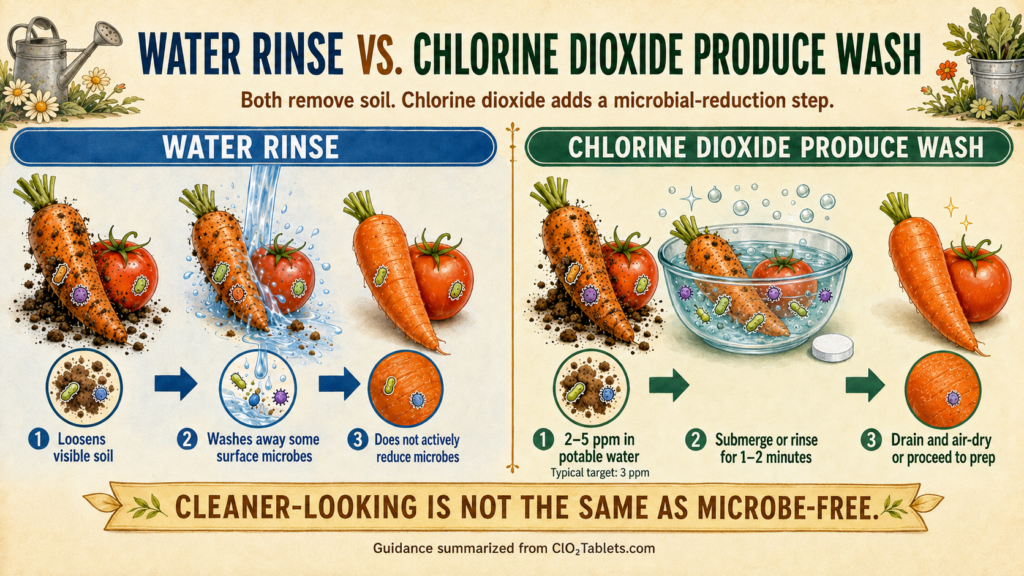
Today, I brush away the loose soil outdoors when I can. Then I carry them inside and clean them beneath running water, using a clean produce brush to reach the stubborn little places. If I am using a ClO₂ product specifically labeled for produce, I follow its directions exactly.
I may no longer bite into a carrot while it still wears a dusting of garden soil, but the experience has not lost its wonder.
The water runs brown for a moment. Then the brilliant orange begins to appear beneath my hands, just as I remember it.
It is the same fresh carrot.
The same satisfying crunch.
Just a little more care between the garden and the first bite.
Also Read 👚What Fabric Softener Really Does to Your Clothes
When the Harvest Became Supper
Once everything was washed, the kitchen changed.
The vegetables were no longer simply the day’s harvest. They were becoming supper.
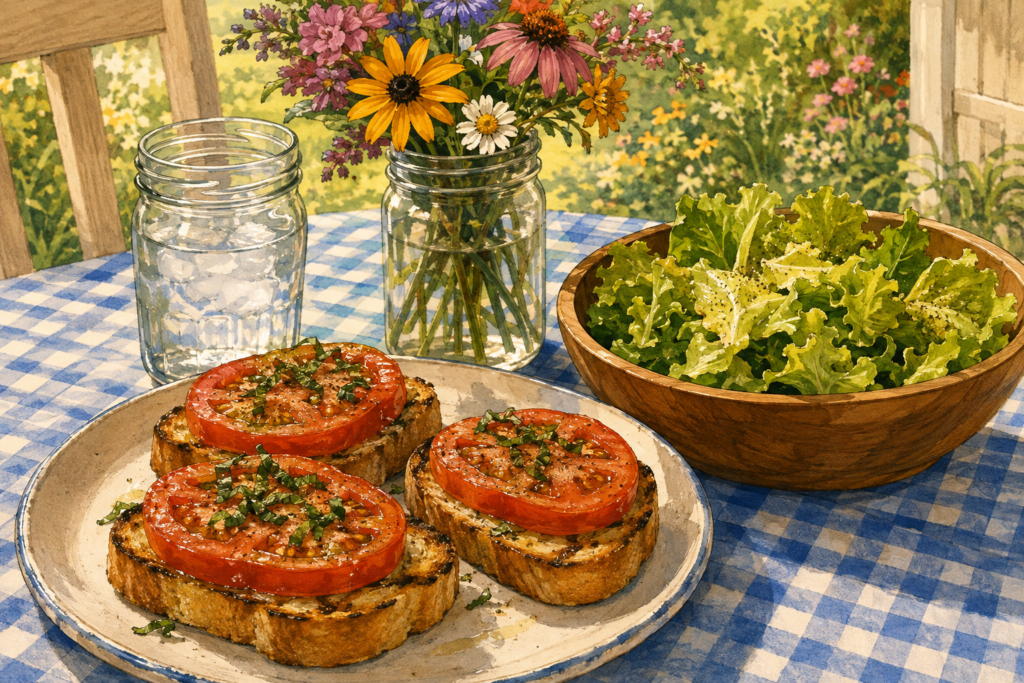
The tomatoes were sliced thickly. Cucumbers fell into cool green circles. Lettuce leaves filled the old wooden bowl. Basil released its fragrance the moment it was torn, and somehow that one scent made the entire kitchen smell like summer.
There might have been olive oil, salt and a splash of vinegar. There might have been cheese crumbled over the top or warm bread waiting nearby.
But the meal did not need much.
Food that has traveled only a few steps—from the garden path to the kitchen sink and then to the cutting board—already has a story.
You can taste the sunlight in it.
You can taste the waiting.
You can taste the care.
The Kind of Homemaking I Still Believe In
There is a version of homemaking that can feel like a performance.
The perfect dress. The spotless kitchen. The carefully arranged basket of vegetables with no mosquitoes, muddy footprints or forgotten dishes anywhere in sight.
But that is not the version I remember.
The homemaking I know is more human than that.
It is bringing in tomatoes with dirt beneath your fingernails. It is wiping the counter twice because the first cucumber rolled through a little trail of soil. It is cutting vegetables while someone asks when dinner will be ready. It is a dish towel slipping from your shoulder and a child—or grandchild—stealing a strawberry when they think you are not looking.
It is not about proving how beautifully you can keep a home.
It is about loving the people who live there.
Sometimes that love looks like clean sheets or an open window. Sometimes it looks like taking a few extra minutes to wash the vegetables before placing them on the table.
Clean is not perfection.
Clean is care.
Also Read: The Science of Odor Elimination: What Freshener Companies Don’t Want You to Know
Keeping the Garden Magic While Changing the Ritual
Long after summer has passed, I can still return to that garden in my mind.
I am a child again, kneeling in the warm earth and pulling a carrot by its feathery green top. I brush it against my clothes and take a bite with a little soil still clinging to the skin.
I can remember exactly how it tasted.
I would not eat it that way today. Knowing more does not spoil the memory; it simply teaches us how to care for the next generation a little differently.
Now, I carry the basket inside.
Sunlight spills across the kitchen floor. Cool water runs over the carrots, tomatoes and cucumbers that were growing outside only minutes ago. I clean them carefully, dry them and bring them to the cutting board.
Then I slice the first tomato, sprinkle it with salt and taste it before doing anything else.
For one quiet moment, the whole season is there—the warm garden, the cool water, the scent of tomato leaves and the simple satisfaction of eating something gathered with my own hands.
That is what I love about these small rituals.
They ask so little from us, and yet, somehow, they give so much back.
A cleaner harvest. A calmer kitchen. Food shared with the people we love.
And a summer afternoon we can remember long after the garden has gone still.

Frequently Asked Questions About Cleaning Garden Produce
1. Should homegrown fruits and vegetables be washed before eating?
Yes. Homegrown produce can carry soil, organic debris and microorganisms from water, wildlife, pets, compost and other parts of the garden environment. Wash produce before cutting, preparing or eating it.
2. Is it safe to eat a carrot directly from the garden?
It is safer to wash the carrot first. Even a familiar backyard garden may contain bacteria, animal waste, lead, pesticide residue or other substances that cannot be identified by sight, smell or taste.
3. Does rinsing garden produce with water remove microbes?
Running water can loosen visible soil and wash away some surface microbes, but it does not make produce sterile or eliminate every microorganism. Firm produce can also be gently rubbed or cleaned with a clean produce brush.
4. What is ClO₂?
ClO₂ is the chemical formula for chlorine dioxide. Properly formulated chlorine dioxide products are used in certain food-processing, agricultural-water and post-harvest sanitation applications to help reduce susceptible microorganisms.
5. Can ClO₂ tablets be used to clean fruits and vegetables?
Only use a ClO₂ tablet on fruits and vegetables when its product label specifically authorizes direct produce washing. Household-cleaning, laundry and odor-control tablets should not be assumed to be suitable for food.
6. How does a labeled ClO₂ produce wash differ from water alone?
Water primarily carries away loose soil, debris and some surface microbes. A properly prepared ClO₂ solution labeled for produce washing adds an oxidation step that can help reduce susceptible microorganisms when used at the labeled concentration and contact time.
7. Can I make a ClO₂ solution stronger for especially dirty vegetables?
No. Do not add extra tablets or reduce the amount of water. More is not necessarily more effective or safer. Prepare and use the solution exactly as directed on the product label.
8. Should produce be rinsed after using a ClO₂ produce wash?
Follow the product label. If it requires a potable-water rinse after treatment, rinse the produce thoroughly before preparing or eating it. Never guess about rinsing requirements or contact times.
9. Can ClO₂ be mixed with vinegar or other cleaning products?
No. Never mix ClO₂ tablets or prepared solutions with vinegar, household bleach, ammonia, acids or other cleaning products. Use ClO₂ only as directed and prepare it in a clean container.
10. How should different types of garden produce be cleaned?
Gently rub tomatoes and peppers, use a clean produce brush on firm vegetables such as carrots and cucumbers, separate and rinse leafy greens, and handle strawberries carefully. Always follow the label when using a product specifically approved for produce washing.
What You Should Do Next. . .
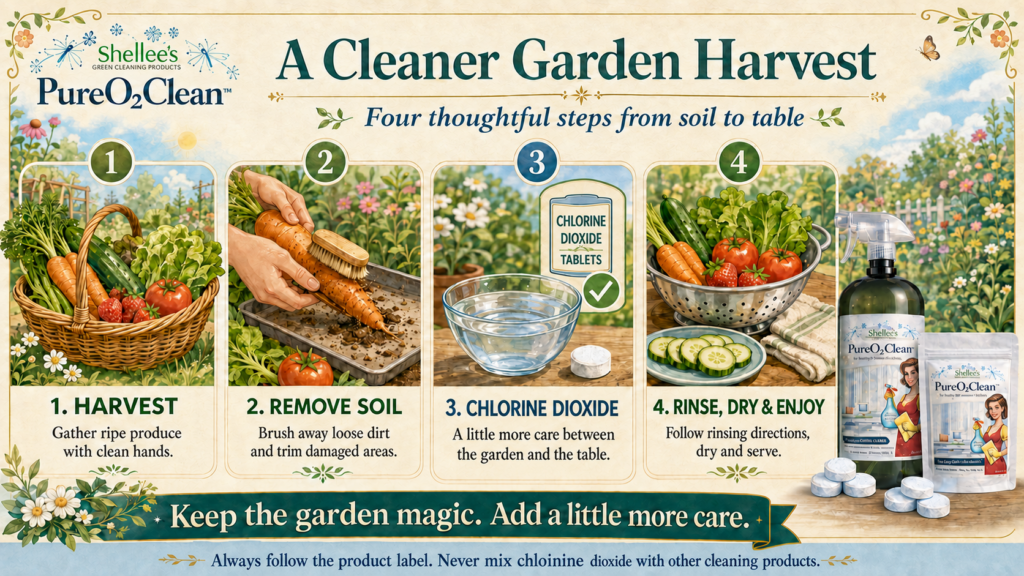
The next time you bring a basket of sun-warmed vegetables in from the garden, let the magic linger—but do not skip the cleaning step.
Begin with clean hands, a clean sink and a clean produce brush. Remove loose soil outdoors when possible, inspect everything for damaged or spoiled areas, and keep your freshly harvested produce away from surfaces used for raw meat.
If you plan to use ClO₂ tablets, check the package before placing anything in the water. Use only a product specifically labeled for washing produce, prepare it with the exact amount of water directed, and follow every contact-time and rinsing instruction. Never add an extra tablet or mix the solution with another cleaning product. If the label does not clearly allow direct produce washing, use cool running water instead.
Then dry your harvest, carry it to the cutting board and enjoy it.
Slice the tomato while it still holds a little of the afternoon’s warmth. Cut the cucumber into crisp coins. Wash the carrot that once might have been eaten with a bit of dirt still clinging to it—and let the first clean crunch take you back to the garden of your childhood.
You do not have to choose between nostalgia and what we know now. You can preserve the sweetness of those memories while giving your family a cleaner, more thoughtful way to enjoy the harvest.
That is the next step: keep the wonder, follow the directions and add a little more care between the soil and the table.
Because clean is not about perfection.
It is about love.