


When Did Laundry Day Become So Complicated?
A little laundry-room nostalgia, and a practical way out of product overload
There was a time when laundry day sounded like the clunk of a washer, the snap of a sheet on the line, and somebody calling from the next room, “Check the pockets first!”
There might have been a basket, a bottle of detergent, and a stain stick for whatever happened at dinner. You sorted a little, washed a load, and got on with your day. The clothes came back smelling like clothes and maybe a little sunshine.
Now? I can stand in the laundry aisle and feel as though I need a flowchart. Detergent. Booster. Scent beads. Fabric softener. Laundry rinse. Sanitizer. Odor eliminator. Dryer sheets. A different bottle for towels, gym clothes, delicates, and the things that somehow smell strange after they've been washed.
When did an ordinary load of socks become a seven-step routine?
How The Laundry Shelf Got So Crowded
Not every new product is silly. Modern closets have synthetic athletic fabrics, stretch fibers, and care labels our grandparents rarely had to consider. Efficient washers use less water, which makes the right detergent and dose more important. And a stubborn stain can call for a little extra help.
But a useful product for a particular problem can quickly turn into a product we reach for every Tuesday without asking why. We buy scent beads because the detergent does not smell strong enough, a rinse because the clothes feel coated, and another booster because the towels still smell musty. Pretty soon, we are troubleshooting the routine with more products instead of finding out what went wrong.
Here is the question I like to ask before opening another bottle: What job does this product do that my current routine cannot?
If the answer is clear, it might earn its place. If the answer is “I suppose laundry is meant to have it,” we can pause.
What All Those Bottles are Actually For
| Product | Its job | When it makes sense |
|---|---|---|
| Detergent | Lifts everyday dirt, body oils, and many stains so they can wash away. | Nearly every ordinary load; use the amount on the label for the load and soil level. |
| Stain pretreatment | Gives a particular spot more attention before washing. | Food, grease, grass, or other visible stains; check the fabric care label first. |
| Laundry booster | Adds a targeted cleaning function, depending on its ingredients. | An occasional issue that the normal wash does not resolve. “Booster” alone tells you very little; read the label. |
| Laundry rinse | May target residue or minerals, or may mainly add fragrance; formulas differ. | When you know which of those jobs you want and the particular product is suited to it. |
| Fabric softener or dryer sheet | Changes fabric feel, reduces static, and sometimes adds scent. | An optional preference; check care labels, especially for performance fabrics and flame-resistant garments. |
| Scent beads | Add fragrance to the wash. | Only if you want extra scent; they are not a substitute for detergent or stain removal. |
| Laundry sanitizer | Reduces specified microorganisms when its label directions are followed. | A particular hygiene need and a product labeled for the intended laundry use, rather than every everyday load. |
Notice how many of these products do something, yet few are required to wash an ordinary basket of clothes. The American Cleaning Institute advises using the proper amount of detergent and following fabric care instructions; both too much and too little detergent can leave clothes less clean. Read its laundry product guidance.
Also Read 👚The Power of D-Limonene: A Smarter Way to Remove Stains Naturally
“Fresh” Should Not Require a Fragrance Orchestra
I understand the appeal of a favorite laundry scent. I also know the feeling of pulling out a clean towel and wondering why it smells like three different perfumes having an argument.
Scent beads can add fragrance, but fragrance does not tell us whether oils and soil were removed. If a workout shirt smells fine straight from the dryer and smells bad again when it gets warm, I would look at the wash routine and the fabric before buying something stronger-smelling. Was the load too full? Was the garment left damp in the washer? Was it washed according to its care label? Is the detergent suited to the machine and being measured correctly?
The same goes for that damp, shut-the-lid smell in towels. Start with a complete wash, enough room for items to move, prompt drying, and a check of the washer itself. A fragrance product can make a towel smell different. It cannot dry a damp towel or fix a washer that needs cleaning.
If you enjoy a scent, enjoy it. Just let it be a choice, not the test of whether your laundry is clean.
Also read 👚The Problem With One-Size-Fits-All Cleaning Products | Shellee’s Green Clean
Do We Need to Sanitize Every Load?
Usually, a regular laundry routine is the place to begin. Sanitizing is a specific task, and a product should be used according to its actual label directions, including the load type and conditions needed for its claim. A pleasant smell, an oxygen booster, or the word “clean” on a bottle does not by itself establish a sanitizing effect.
When someone at home is sick, the CDC advises laundering items according to their care instructions, using the warmest appropriate water setting, and drying them completely. That is a more useful starting point than automatically pouring a sanitizer into every load. For a particular infection or care setting, follow the relevant medical and product guidance. See CDC laundry guidance.
And please do not combine laundry chemicals on a hunch. Follow each product and machine label; never improvise a mixture in the dispenser.
Also Read 👚Essential Oils vs Fragrance Oils: What’s the Real Low-Down?
A Simpler Laundry Day, One Load at a Time
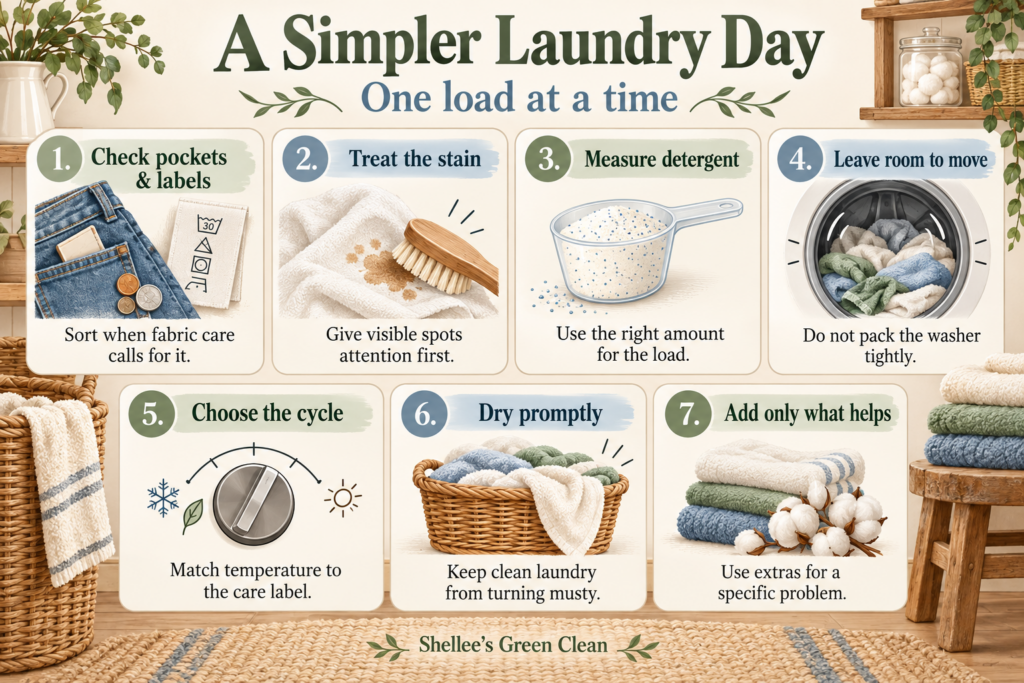
Here is the routine I would put on a little card above the washer:
- Read the care label. Separate by color and fabric needs when it matters, and empty those pockets.
- Treat the actual stain. A little attention before the wash beats a whole extra bottle poured into every load.
- Use one detergent, measured correctly. Check whether your machine calls for high-efficiency detergent. More detergent does not automatically mean more clean.
- Give the clothes room to move. A tightly packed drum makes washing and rinsing harder.
- Choose the right cycle and temperature. Cold water is useful for many ordinary loads when the garment and detergent allow it; follow the care label for exceptions.
- Dry promptly and completely. Do not let a clean load turn into tomorrow's musty mystery.
- Add a specialty product only when you can name the problem. Keep the one that solves it; skip the others.
Try that for a couple of weeks with your usual laundry. If the towels still feel stiff, the sportswear still holds odor, or a stain refuses to budge, investigate that problem. Hard water, residue, machine upkeep, fabric type, and drying habits do not all have the same solution.
What Nostalgia Can Teach Us Without Pretending the Past was Perfect
I am not going to tell you that every old laundry day was easier. Someone had to scrub the grass out of those knees, wring out the hand-washables, and hope it did not rain on the sheets. Modern detergents and washers have made plenty of things better.
What I miss is the permission to keep the routine understandable. The basket did not need its own supporting cast. A clean shirt did not have to announce itself from across the room. And we trusted ourselves to notice when a particular load needed a little extra care.
Maybe that is the piece worth bringing back: a bottle that does its job, a few good habits, and the confidence to walk past an aisle full of promises without taking them all home.
Also Read 👚What Fabric Softener Really Does to Your Clothes
Frequently Asked Questions
Do I need a laundry booster with every load? No. Start with an appropriate detergent and a sound wash routine. Use a booster when you can identify a specific problem and the product directions address it.
Do scent beads clean clothes? Their main purpose is added fragrance. Use detergent for cleaning and pretreat stains as needed.
Is laundry rinse the same as fabric softener? Not necessarily. Products sold as rinses vary; some focus on residues or minerals and others on scent. Read the particular label. Shellee takes a closer look at laundry rinse here.
Should I use sanitizer on every load? It is generally a targeted product, not a required step in routine laundry. Use an appropriately labeled product according to its directions when you have a specific hygiene need.
Why do clean towels smell musty? Damp storage, delayed drying, an overloaded wash, or a washer that needs attention are all possibilities. Check the process before masking the odor with fragrance.
Can too much detergent make laundry worse? Yes. The proper amount depends on the product, load, and soil level; follow the label and machine directions.
Do I have to use fabric softener? No. It is an optional product for feel, static, or scent. Follow the garment's care instructions before using it. Read Shellee’s discussion of fabric care.
What is the simplest effective laundry routine? Sort when needed, pretreat visible stains, measure an appropriate detergent, choose the right cycle, and dry items promptly.
Can I wash everything in cold water? Many ordinary items can be washed in cold water when the care label and detergent permit it. Some fabrics, soils, and hygiene situations need a different approach.
What should I buy first if I want fewer laundry products? Choose a detergent suited to your washer and fabrics. Live with that baseline before adding a product for a problem you have actually observed.
Shellee’s Says. . .
At Shellee’s Green, I believe a product should earn its spot on the shelf. If your laundry routine feels crowded, start by looking at what each bottle is doing. Keep the help you actually use. Let the rest go.
If you are looking for a straightforward place to begin, explore Shellee’s laundry products and choose the care that fits your fabrics and your household. Then put on a load, check the pockets, and go enjoy the rest of your day.
What to Do Next: Give Your Laundry Shelf a Little Breathing Room
You don’t have to throw out every bottle or perfect your routine by next Tuesday. Start with one ordinary load. Check the care labels, treat any visible stains, measure your detergent, and leave enough room in the washer for everything to move. Then take the laundry out promptly and notice how it looks, feels, and smells when it’s dry.
If something still needs attention, name the problem before reaching for another product. Is it a stain, a musty towel, or a shirt that holds onto odor? Choose help for that load. The bottles that solve a problem can stay. The ones you keep adding out of habit don’t need to run laundry day.
That sounds a little more like the laundry I remember: a basket, a dependable routine, and time left for the rest of life. If you’re ready to simplify your shelf, explore Shellee’s laundry products and choose what fits the clothes and little messes in your home.