


🧽 Why the Same Cleaner Doesn’t Work for Every Home
Walk down the cleaning aisle of any store and you’ll see a familiar promise: one bottle that cleans everything. Counters, bathrooms, kitchens, floors—apparently all surfaces can be handled by the same formula.
It sounds convenient. But in reality, homes aren’t one-size-fits-all—and neither are cleaning products.
Every household has different surfaces, materials, messes, sensitivities, and priorities. What works safely on one surface can damage another. What cleans quickly in a commercial environment may introduce chemicals many families would rather avoid at home.
At Shellee’s Green Clean, we believe cleaning should be intentional, effective, and safe for the people and pets living in the space. That means understanding why universal cleaners often fall short—and why smarter, more thoughtful cleaning solutions make a real difference. 🌿
A Short History of Convenience Cleaning
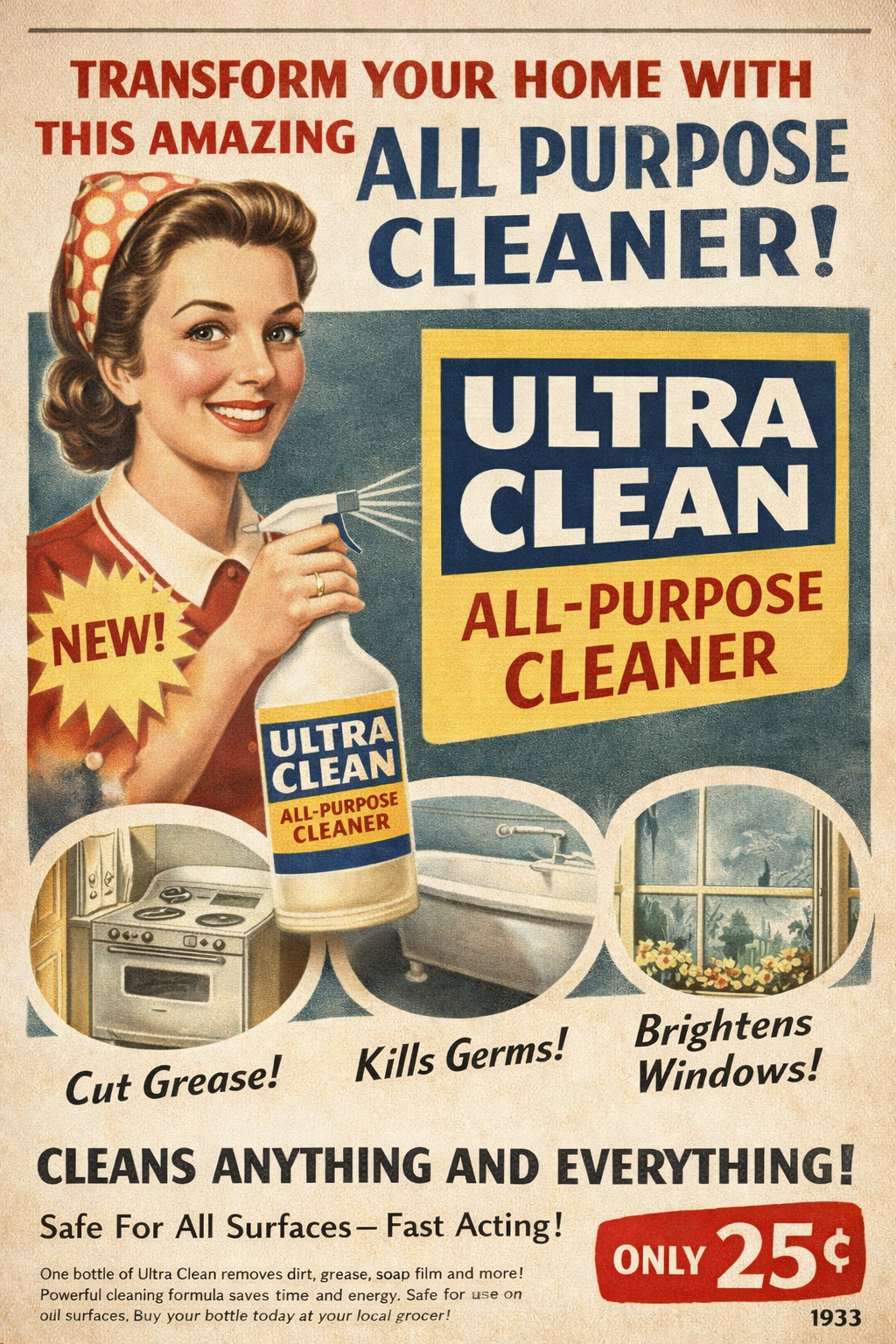
The rise of the all-purpose cleaner is closely tied to the growth of modern chemical manufacturing and advertising in the early 20th century. Before this shift, homes relied on simple, task-specific solutions like soap, vinegar, and baking soda. As industrial chemistry advanced, companies began promoting the idea that one product could simplify housework by cleaning nearly every surface in the home. The concept was marketed as a symbol of modern convenience, especially during the mid-century boom in household consumer goods.
Key moments in the all-purpose cleaner movement:
• Pre-1920s: Homes relied on simple, natural cleaners like soap flakes, vinegar, and baking soda for specific cleaning tasks.
• 1920s–1930s: Industrial chemistry began producing synthetic detergents and multi-purpose formulas aimed at simplifying housework.
• 1940s–1950s: Post-World War II manufacturing expansion fueled aggressive advertising for “miracle” cleaners that could tackle every surface.
• 1960s–1980s: Supermarket cleaning aisles grew as brands competed to market stronger, more convenient all-purpose products.
• Modern era: Many homeowners are rediscovering that different surfaces and messes benefit from more targeted, thoughtful cleaning solutions rather than a single universal formula.
Why “All-Purpose” Cleaners Became Popular
All-purpose cleaners rose to popularity for a simple reason: convenience.
Manufacturers designed products meant to tackle a wide variety of surfaces so consumers could avoid buying multiple cleaners. The idea sounds efficient, but the chemistry behind cleaning is far more nuanced.
Different surfaces react differently to:
- pH levels
- solvents
- disinfecting agents
- fragrances
- surfactants (the ingredients that break down grease)
A formula designed to handle everything moderately well often means it’s not optimized for anything specifically.
That’s where the problems begin.
Also read🌻A Guide to Cleaning with CLO₂ | Safe, Family‑Friendly Green Cleaning
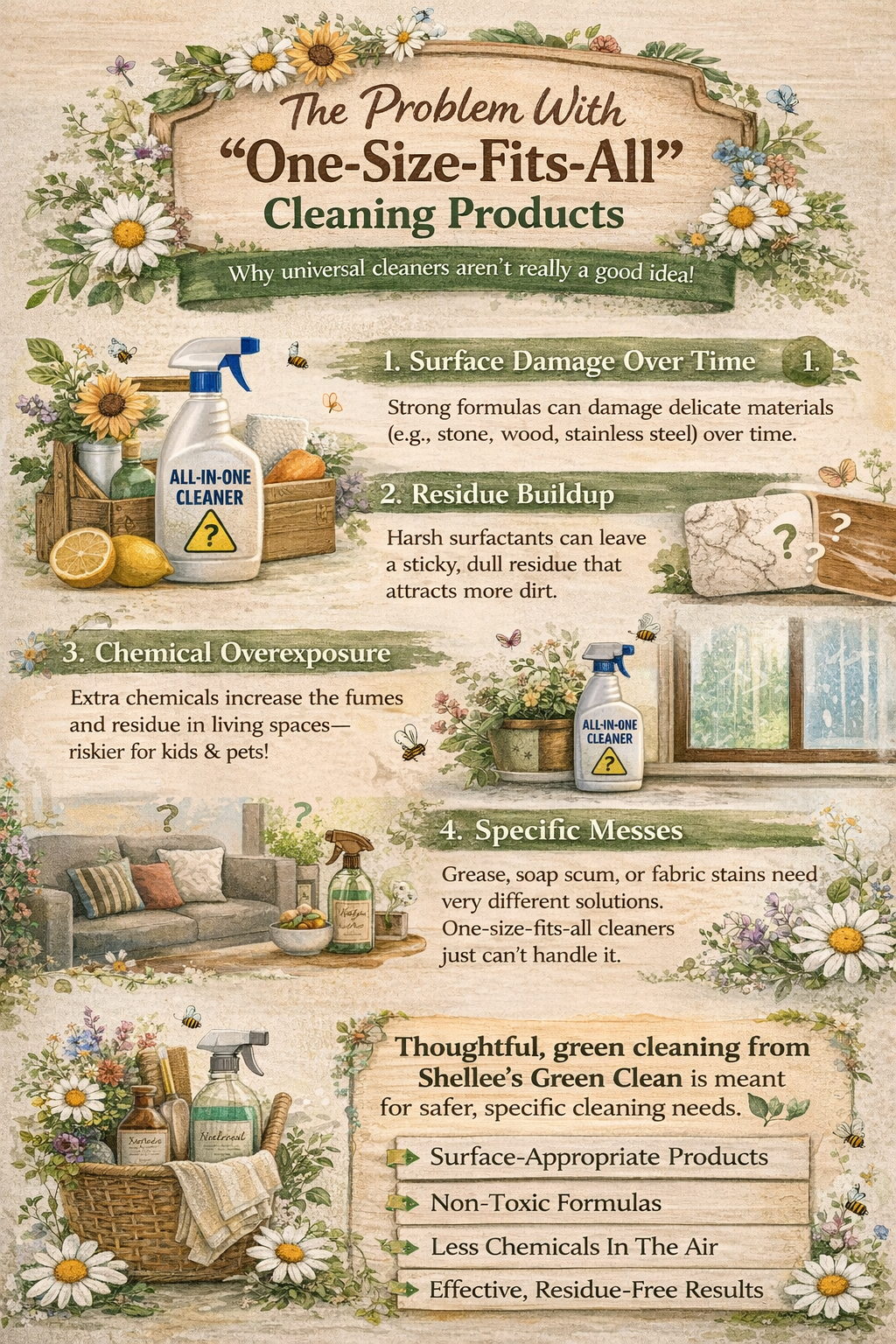
The Hidden Problems With One-Size-Fits-All Cleaners
Why Thoughtful Cleaning Works Better
At Shellee’s Green Clean, the philosophy is simple:
Use the right solution for the right job.
Instead of forcing one chemical formula to do everything, a thoughtful cleaning routine focuses on:
🌿 Surface-appropriate products
🌿 Safer ingredient choices
🌿 Minimal chemical exposure
🌿 Effective results without residue
This approach not only protects surfaces—it also creates a healthier home environment.
Cleaning should support the well-being of the people living in the space, not just make surfaces look shiny.
Also read🌻The Science of Odor Elimination: What Freshener Companies Don’t Want You to Know
The Green Cleaning Difference
Green cleaning doesn’t mean weak cleaning.
In fact, many modern green cleaning technologies rely on targeted chemistry designed to break down specific types of contamination without unnecessary additives.
A smarter approach includes:
✨ plant-based surfactants that remove dirt without residue
✨ oxygen-based cleaners that break down organic stains
✨ odor-neutralizing technologies that eliminate smells instead of masking them
✨ biodegradable ingredients that reduce environmental impact
When products are designed with purpose instead of convenience marketing, cleaning becomes both safer and more effective.
Homes are wonderfully complicated little ecosystems. Grease behaves one way, mineral deposits another, and everyday dust follows its own mischievous physics. Treating all of that with a single chemical formula is like trying to fix every mechanical problem with one wrench. Shellee’s Green Clean approaches things differently. Instead of forcing one product to do everything, we focus on natural, purpose-driven cleaning options designed for the specific job at hand. Whether it’s cutting kitchen grease, lifting organic stains, refreshing fabrics, or gently cleaning delicate surfaces, there are safer, plant-based and environmentally thoughtful solutions that work with the chemistry of the mess rather than against it. The result is a cleaning approach that’s both effective and kind to the home itself—surfaces stay protected, indoor air stays fresher, and families can enjoy a clean space that truly feels healthy and welcoming. 🌿🏡
Check out our products https://shelleesgreenclean.com/shop/
The Takeaway: Your Home Deserves Better Than “Good Enough”
Cleaning products shouldn’t treat your home like a laboratory experiment.
Your kitchen counters, bathroom surfaces, furniture, floors, and fabrics all have unique needs. Using a single formula for everything may seem convenient—but it often leads to inefficient cleaning, surface wear, and unnecessary chemical exposure.
Choosing thoughtful, purpose-driven cleaning solutions allows your home to stay:
🌿 cleaner
🌿 healthier
🌿 safer for families and pets
And that’s exactly the kind of clean Shellee’s Green Clean believes in.
Because a home isn’t one-size-fits-all—and your cleaning routine shouldn’t be either. 🏡✨
Frequently Asked Questions
1. Why don’t all-purpose cleaners work well on every surface?
All-purpose cleaners are designed to handle many types of dirt and surfaces, but they are rarely optimized for any specific task. Different materials—such as wood, stone, glass, or stainless steel—respond differently to cleaning chemistry. A formula that works well for grease may be too harsh for delicate surfaces.
2. Can one-size-fits-all cleaners damage surfaces in my home?
Yes. Repeated use of the wrong cleaner can slowly degrade certain materials. Acidic formulas can dull natural stone, strong degreasers can dry out wood finishes, and abrasive ingredients can damage stainless steel or protective coatings.
3. Why do some cleaning products leave streaks or residue?
Many conventional cleaners contain surfactants, fragrances, and additives that remain on surfaces after wiping. These residues can create streaks on glass and stainless steel and may even attract more dirt over time.
4. Are green cleaning products actually strong enough to clean?
Modern green cleaning products can be very effective. Many rely on plant-based surfactants, oxygen-based cleaning agents, and biodegradable ingredients that break down dirt and stains without unnecessary chemical additives.
5. Is it safer to use different products for different cleaning tasks?
In many cases, yes. Using a cleaner specifically designed for a surface or type of mess allows the product to work more efficiently while reducing the risk of surface damage or chemical overuse.
6. Why do some cleaning products have strong fragrances?
Strong fragrances are often added to mask chemical odors rather than remove the source of a smell. True odor control typically involves breaking down odor-causing compounds rather than covering them with perfume.
7. What types of messes require specialized cleaning products?
Different types of contamination require different approaches. Grease in kitchens, mineral buildup in bathrooms, organic stains on fabrics, and dust on furniture each respond best to different cleaning chemistry.
8. Are one-size-fits-all cleaners safe for homes with children and pets?
Some general-purpose cleaners contain stronger chemicals intended for heavy-duty cleaning. Many families prefer simpler formulas with fewer additives when cleaning everyday living spaces where children and pets spend time.
9. Does using the wrong cleaner make surfaces get dirty faster?
It can. If a cleaner leaves behind residue, that layer can attract dust and grime. Over time, this buildup can make surfaces appear dull or dirty even shortly after cleaning.
10. What is the biggest benefit of using thoughtful, green cleaning products?
A thoughtful cleaning approach protects surfaces, reduces unnecessary chemical exposure, and often provides longer-lasting results. The goal is not just a quick shine—it’s a healthier and more sustainable clean for the entire home. 🌱